

Measuring marketing ROI has never been more difficult or more important. Customers no longer follow the simple path of clicking on an ad to purchase an item. Customers travel through many touchpoints across multiple channels like social media, paid search, email campaign communications, content marketing, affiliate, sometimes offline, before converting. Not being able to assign true responsibility to all these touch points on this journey compromises our ability to attribute actual value once the customer converts.
This is where attribution modeling comes into play. Attribution models provide marketers with a means to understand which channels/campaigns/interactions are relevant/best contributors to conversions/revenue. By applying the right model, it allows the brand to not only simply optimize spend but to improve ROI by ultimately focusing on what drives results.
In this blog, we will detail the most effective attribution models for 2025, break down the functional strengths and weaknesses, and discuss how the different models can make your marketing a more predictable, ROI-focused growth engine.
Why Traditional Attribution is Inadequate
Marketers have long depended on simplistic attribution models like last-touch, which credits the last click prior to conversion, or first-touch, which gives 100% credit to the initial encounter.


Despite being simple to use, these models are unable to adequately represent the complexity of contemporary consumer behavior. While a last-click model would indicate that the entire conversion was driven by a Google search, it’s possible that the customer first interacted with a Facebook ad, then went to your blog, received an email nurture sequence, and last looked for your brand on Google before making a purchase.
Ignoring the multi-touch reality of modern marketing creates the risk of;
- Putting too much money on channels that seem to “close” conversions
- Undervaluing the impact of campaigns to raise awareness
- Budget misallocation that eventually impedes growth
Because improved attribution models tell the real story of the customer experience, they will be crucial in 2025 and beyond.
Linear Attribution: Each Touchpoint Has the Same Weight
Every touchpoint in the buyer’s journey receives the same amount of credit under linear attribution. A 20% credit would be given to any customer who engaged with five distinct channels prior to converting.

The Reason It Works
- Equitable distribution: It is perfect for omnichannel strategy since each channel is recognized.
- Promotes brand investment: Mid-funnel channels and awareness aren’t written off as “unprofitable.”
Where It Is Insufficient
- No nuance: An email reminder received the day before a purchase may have a greater impact than a display ad viewed early in the funnel.
- Budget inefficiencies: Weak touchpoints may be overvalued if all channels are given equal weight.
Best Use Case in Marketing
Longer sales cycles with several touchpoints (such as B2B SaaS or healthcare decisions) are ideal for linear attribution. Even if mid-funnel content isn’t the ultimate conversion driver, it helps marketers understand the wider picture and continue to invest in it.
Example: To guarantee that mid-funnel webinars and top-of-funnel LinkedIn advertisements receive credit alongside bottom-funnel demos, a B2B software company may employ linear attribution.
Time-Decay Attribution: Giving Recent Touches More Weight
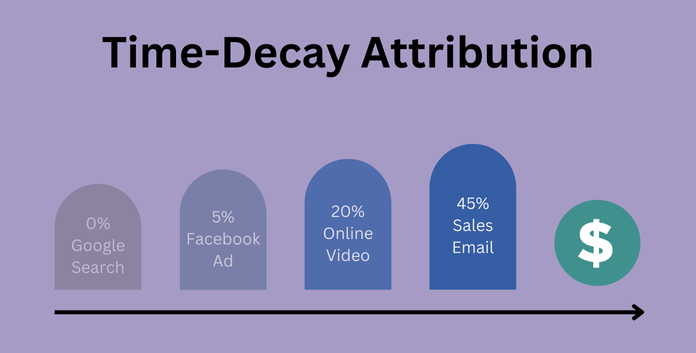
Interactions that take place closer to the conversion event are given more weight with time-decay attribution.
The Reason It Works
- Stresses urgency: Understands the need of final nudges, such as email offers or remarketing advertisements.
- Realistic: Acknowledges that not every touchpoint is created equal.
Where It Is Insufficient
- Undervalues early awareness: Brand-introducing channels, such as influencer marketing or social media advertisements, are frequently overlooked.
- Marketing professionals may overemphasize bottom-funnel strategies as a result of shortsighted optimization.
Best Use Case in Marketing
Perfect for limited-time promotions or brief sales cycles, like flash discounts or holiday marketing. It identifies the end-of-funnel strategies that work best for closing deals.
Example: Time-decay attribution might be used by an eCommerce company operating a Black Friday campaign to demonstrate the importance of retargeting advertisements and last-day promotional emails in boosting conversions.
Position-Based Attribution: U-Shaped and W-Shaped Models
Position-based attribution emphasizes the first and last touchpoints, with additional weight distributed across middle interactions.

- U-shaped model: Usually distributes the remaining 20% among midway encounters, with 40% going to the initial touch and 40% to the last touch.
- W-shaped model: Comparable to the U-shaped model, but it also emphasizes a crucial “opportunity generation” touchpoint, which is frequently a lead-gen form or demo request.
The Reason It Works
- Strikes a balance between awareness and closing: Recognizes the significance of both initial impressions and ultimate conversion factors.
- Focuses on crucial actions: When a lead formally enters the sales pipeline, it is identified by W-shaped models.
Where It Is Insufficient
- Bookends may be overemphasized: May place too little attention on nurturing strategies like retargeting or content.
- Predetermined weights: Makes the assumption that the first and last touchpoints are usually the most significant, even though this isn’t necessarily the case.
Best Use Case in Marketing
Excellent for lead generation campaigns in which the last call-to-action completes the conversion, and the initial blog post or advertisement raises awareness. In B2B marketing, where opportunity creation is a clear milestone, the W-shaped strategy excels.
Example: A healthcare provider may consider the initial blog visit, filling out the lead form, and scheduling an appointment to be the three most crucial steps in the funnel.
Data-Driven / Algorithmic Attribution: Powered by AI and Statistics
Data-driven attribution determines the likelihood that each channel contributed to conversion using Shapley value methods, Markov chains, or machine learning. Instead of making assumptions, it adjusts to actual customer data, in contrast to rule-based models.

The Reason It Works
- Extremely accurate: Captures each channel’s true function in the consumer journey.
- Dynamic: Changes in response to the campaign data, unlike static models.
Where It Is Insufficient
- Data-heavy: Needs a lot of precise, historical data and takes a lot of time and effort to set up.
- Complexity: More difficult to communicate to stakeholders than rule-based frameworks.
Best Use Case in Marketing
Ideal for companies with big budgets and data-heavy campaigns where ROI scaling requires accuracy.
Example: Using algorithmic attribution, an enterprise retailer with millions of impressions from sponsored search, affiliates, and social media could discover that Instagram advertisements increase conversions when combined with email follow-ups, information that rule-based models would have overlooked.
Hybrid / Custom Attribution: Tailored to Your Funnel
Hybrid models generate attribution that are particular to a brand’s objectives by combining machine learning changes with rule-based frameworks (such as time-decay or position-based).

The Reason It Works
- Customizable: Able to be in line with long-term objectives such as customer lifetime value (CLV).
- Accuracy and simplicity are balanced: Provides useful information without becoming overly complicated.
Where It Is Insufficient
- Requires constant calibration: To stay effective, it must be continuously improved.
- Not universally applicable: Personalization may require a significant amount of resources.
Best Use Case in Marketing
Great for brands looking to strike a balance between conversions and brand development, making sure that long-term awareness investments aren’t overlooked.
As an illustration, a subscription box business may create a hybrid attribution model that prioritizes both the initial click on the subscription advertisement and the follow-up engagement emails that promote retention.
New Developments in 2025 Attribution Trends
AI-driven algorithms are taking the lead as marketing data gets more complicated. Amazon’s hybrid multi-touch attribution and LinkedIn’s transformer-based AI attribution model, LiDDA, both demonstrate the future by fusing real-time data with statistical precision.
Privacy-first attribution is another significant development. Marketers now must rely more on first-party data, aggregated analytics, and probabilistic modeling to gauge impact without compromising compliance as a result of third-party cookies becoming deprecated.
Conclusion
Finding the attribution model that best suits your sales cycle, data maturity, and company objectives is more important than pursuing the most advanced alternative.
- To make sure every touchpoint is valued, use linear attribution.
- For advertisements with a sense of urgency, go with time-decay.
- Use position-based models for B2B and lead generation funnels.
- In the event that you possess the scale and data, utilize data-driven attribution.
- Try using hybrid models to tailor your funnel’s insights.
In 2025, effective marketers should view attribution as a strategic driver of ROI and a guide for more intelligent, lucrative campaigns, rather than just a reporting tool.